
The uncertainty around the global economy following U.S. tariffs and the Government of Canada’s countermeasures has continued to strain Canadian businesses. This week, the federal government announced a $7.5 billion support package to continue bolstering workers and employers across the country, including new and updated programs. Note that the resources below are non-exhaustive as new resources are continuing to be released while the turbulent situation evolves. A comprehensive breakdown of programs, including ones designated for specific sectors is available on the Government of Canada’s website.
Work-Sharing Program
The Government of Canada announced special measures to the Work-Sharing Program, initially effective from March 7, 2025, and now extended until March 31, 2027.
The Work-Sharing Program is a 3-party agreement between the Government of Canada (Service Canada), employers, and employees to help avoid layoffs in a time where there is a decrease in normal business activity beyond the employer’s control. Employees can agree to work a reduced schedule and share the available work equally, and in return, receive income support from EI benefits.
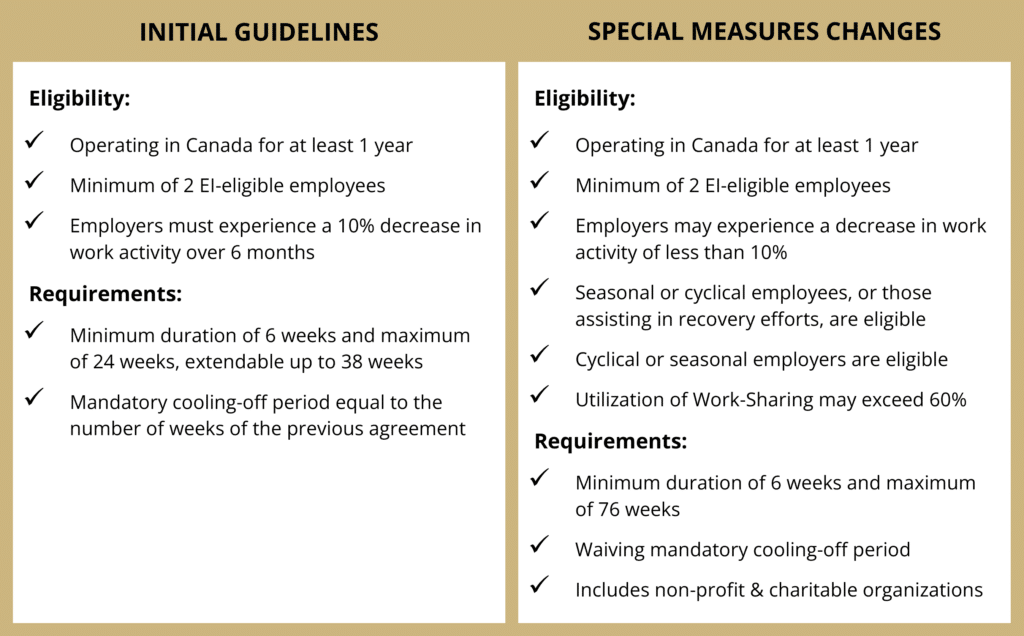
Initially, the agreements had a minimum duration of 6 weeks and last up to 26 weeks (or 38 weeks, if granted an extension). The business also must have been experiencing at least a 10% reduction to their normal weekly earnings to be eligible. After the agreement has ended, a cooling-off period was required equal to the amount of time the agreement was in effect.
Special Measures
In response to the tariffs and the potential impact on businesses, the following special measures have been implemented to temporarily change the eligibility requirements for the Work Sharing Program. The following is a summary of the new measures.
- Must have operated in Canada for a minimum of 1 year
- Must have a minimum of 2 employees eligible for Employment Insurance who agree to the Work-Sharing agreement
- Employers may now be eligible if they are experiencing a reduction in business activity of less than 10% and allows utilization of work-sharing to be exceed 60%
- Includes non-profit and charitable organizations
- Includes employers who are cyclical or seasonal
- Includes employees who are cyclical or seasonal workers or employees who are assisting the employer in recovery efforts
The Work-Sharing agreement’s duration was also revised to a be extendable to a maximum of 76 weeks. Additionally, the cooling-off period between successive work-sharing agreements have been waived.
To learn more about special measures for the Work-Sharing Program, click here.
Regional Tariff Response Initiative
The Regional Tariff Response Initiative (RTRI), originally launched in March 2025, was designed to help small to medium sized businesses and non-profits from trade disruptions and tariffs. This week, the amount of support from RTRI increased to $3.45 billion over 4 years. Eligibility and application dates for these programs are managed by province and can be found on the Government of Canada’s website.
Support for Ontario Workers & Businesses
Ontario has continued providing support and resources to local businesses via a newly released $30 billion tariff relief and support plan, which includes:
- Protect Ontario Financing Program (POFP), originally launched in August 2025, giving financial support to qualifying Ontario companies impacted by the tariffs, such as payroll, lease payments, and utility payments.
- Ontario Together Trade Fund aimed to help small to mid-sized enterprises.
- Trade-Impacted Communities Program assisting local communities and industries reduce their reliance on U.S. markets.
- Ontario Made Manufacturing Investment Tax Credit offering tax relief for capital investment on buildings, machinery, and equipment for manufacturing or processing in Ontario.
Temporary Employment Insurance (EI) Changes
In order to support Canadian workers and their families during the anticipated economic challenges, the Canadian Government is temporarily changing the access requirements for Employment Insurance (EI) benefits.
Waiting Period
The new temporary measure waives the 1-week waiting period before employees begin receiving benefits between March 30, 2025, and October 10, 2026, allowing benefits to begin immediately.
Suspending Allocation of Separation Earnings
Separation earnings, such as vacation pay, pay in lieu of notice, severance pay, closure bonuses, and sick leave credits, will not be deducted from the employee’s benefits between March 30, 2025, and October 10, 2026. This allows employees to receive EI benefits sooner.
Increasing the Weeks of Regular Benefits for Long-Tenured Workers
The temporary measure allows long-tenured workers an additional 20 weeks of regular benefits (up to a maximum of 65 weeks) if they meet specific criteria:
- If they have a claim beginning between June 14, 2025, and October 10, 2026
- If they received at least 1 week of regular benefits
- If they are considered a long-tenured worker as in the following:
- Received fewer than 36 weeks of regular or fishing benefits in the 3 years before the start of the claim
- Paid at least 30% of annual maximum EI premiums for at least 7 of the 10 years before the year the claim began
To learn more about the temporary changes to Employment Insurance (EI), click here.
Need HR support?
If you have questions about the temporary changes for businesses or need further support, contact us today!